Saturday, November 30, 2013

Meaningful Thoughts 0147 - Great Words of Wisdom

1. Rise with the sun to pray. Pray alone & often. God will listen, if you only speak.
2. Be tolerant of those who are lost on their path. Ignorance, conceit, anger, jealousy and greed stem from a lost soul. Pray that they will find guidance.
3. Search for yourself, by yourself. Do not allow others to make your path for you. It is your road, and yours alone. Others may walk it with you, but no one can walk it for you.
4. Treat the guests in your home with much consideration. Serve them the best food, give them the best bed and treat them with respect and honour.
5. Do not take what is not yours whether from a person, a community, the wilderness or from a culture. If it was not earned or given, it is not yours.
6. Respect all things that are placed upon this earth – whether it be people or nature.
7. Honor other people’s thoughts, wishes and words. Never interrupt another or mock or rudely mimic them. Allow each person the right to personal expression.
8. Never speak of others in a bad way. The negative energy that you put out into the universe will multiply when it returns to you.
9. All persons make mistakes. And all mistakes can be forgiven.
10. Bad thoughts cause illness of the mind, body and spirit. Be optimistic.
11. Nature is not FOR us, it is a PART of us. They are part of your worldly family.
12. Children are the seeds of our future. Plant love in their hearts and water them with wisdom and life’s lessons. When they are grown, give them space to grow.
13. Avoid hurting the hearts of others. The poison of your pain will return back to you.
14. Be truthful at all times. Honesty is the test of ones will within this universe.
15. Keep yourself balanced. Your Mental self, Spiritual self, Emotional self, and Physical self – all need to be strong, pure and healthy. Work out the body to strengthen the mind. Grow rich in spirit to cure emotional ails.
16. Make conscious decisions as to who you will be and how you will react. Be responsible for your own actions.
17. Respect the privacy and personal space of others. Do not touch the personal property of others – especially sacred and religious objects.
18. Be true to yourself first. You cannot nurture and help others if you cannot nurture and help yourself first.
19. Respect others religious beliefs. Do not force your belief on others.
20. Share your good fortune with others. Participate in charity.

Friday, November 29, 2013

Meaningful Thoughts 0146 - Attachment

WHAT IS THE PROBLEM WITH ATTACHMENT?

Although attachment may at first appear to be much less destructive than anger and hatred, in terms of being caught up in the uncontrolled process of rebirth, it is actually the bigger evil. Attachment to pleasure and ultimately to life itself as our inborn survival instinct, is the main type of misunderstanding that holds us prisoner in samsara.
An example to illustrate attachment that I love:
In the South of India, people used to catch monkeys in a very special way. Actually they let monkeys catch themselves. What they did is cutting a small hole in a coconut, just large enough for a monkey to put its hand in. Next, you fix the coconut to a tree, and fill it with a sweet. The monkey smells the sweet, squeezes its hand into the coconut, grabs the sweet and .... finds that the fist does not fit through the hole. Now the trick is, that the last thing the monkey will think of is to let go of the sweet; and it holds itself prisoner. Nothing could be easier for a human being who comes and catches it.
The Buddha compared desires to being in debt. If you owe money to the bank for your house, every month you have to pay. In the end, you will own the house. With sensual desires however, you cannot pay off the debt; they arise again and again. Hunger, thirst, lust for sex, warmth, coolness, they all come back again and again. Trying to fulfil our desires is like carrying water to the sea; a never ending task and ultimately completely useless.
In some very direct words of the Buddha:
"I have killed all of you before.
I was chopped up by all of you in previous lives.
We have all killed each other as enemies.
So why should we be attached to each other?"
Ajahn Sumedho, in 'Teachings of a Buddhist Monk':
"Desire can be compared to fire. If we grasp fire, what happens? Does it lead to happiness?
If we say: "Oh, look at that beautiful fire! Look at the beautiful colors! I love red and orange; they're my favorite colors," and then grasp it, we would find a certain amount of suffering entering the body. And then if we were to contemplate the cause of that suffering we would discover it was the result of having grasped that fire. On that information, we would hopefully, then let the fire go. Once we let fire go then we know that it is something not to be attached to.
This does not mean we have to hate it, or put it out. We can enjoy fire, can't we? It's nice having a fire, it keeps the room warm, but we do not have to burn ourselves in it."
John Snelling, from 'Elements of Buddhism':
"If the basic project of mainstream Buddhist practice is to unmask the ego illusion for what it is, one of the main prongs of attack is directed against desire. Desire gets a very bad press in the Buddhist scriptures. It is a poison, a disease, a madness. There is no living in a body that is subject to desire, for it is like a blazing house.
Now, desire lives and grows by being indulged. When not indulged by the application of ethical restraint and awareness, on the other hand, it stabilizes and begins to diminish, though this is not an easy or comfortable process, for the old urges clamor for satisfaction for a long time.
This kind of practice cuts directly against the main currents of modern consumer society, where desire is energetically encouraged and refined to new pitches and variations by the powerful agencies of marketing and publicity. But it also cuts against the more moderate desires-for family, wealth, sense-pleasures and so on sanctioned in simpler, more traditional societies, including the one into which the Buddha was born. We can never be at peace while desire is nagging at us."

THE SUFFERING OF PLEASURE?

It can be a sobering experience when one deeply reflects in meditation on what we normally describe as pleasure. The Buddha said that relative to the blissful experience of release of cyclic existence, everything within cyclic existence issuffering. (See also the first of the "4 Noble Truths".)
Can this make sense?
Please take a few moments to reflect the following thoughts, while taking a pleasurable experience in mind:
- In how far is this "pleasure" simply an escape or a temporary forgetting of daily problems?
- How nice would it be if I kept doing this without interruption for a few days?
- How fulfilled do I feel by this experience after 5 minutes, 5 hours, 5 days?
- To achieve the same great feeling as the first time, do I need more of the same the next time?
The Buddha concluded that putting our energy in grasping for temporary pleasures is not only useless, it creates many problems, also karmic actions which we had better avoided.
From a Buddha's point of view this is exactly what sentient beings do all the time; holding themselves prisoner with their attachment to temporary pleasures and life itself.
"Let me tell you about the middle path. Dressing in rough and dirty garments, letting your hair grow matted, abstaining from eating any meat or fish, does not cleanse the one who is deluded. Mortifying the flesh through excessive hardship does not lead to a triumph over the senses. All self-inflicted suffering is useless as long as the feeling of self is dominent.

You should lose your involvement with yourself and then eat and drink naturally, according to the needs of your body. Attachment to your appetites - whether you deprive or indulge them - can lead to slavery, but satisfying the needs of daily life is not wrong. Indeed, to keep a body in good health is a duty, for otherwise the mind will not stay strong and clear."
From Discourses II

SOME NOTES ON "ORDINARY" LOVE

- "Love with attachment consists of waves of emotion, usually creating invisible iron chains." Ordinary love tends to create bonds that may turn very unpleasant.
- Ordinary love is based on selfishness: attraction to others because they help us.
- Ordinary love is often based on opinions like beauty and status, which may be quite irrelevant or even obstacles for being able to live happily together with the person.
- Exaggeration and projection are the main reasons that ordinary love leads to disappointments. To illustrate this some words from M. Scott Peck on "ordinary love":
"The myth of romantic love is a dreadful lie. Perhaps it is a necessary lie in that it assures the 'falling in love'- experience that traps us into marriage. But as a psychiatrist I weep in my heart almost daily for the ghastly confusion and suffering that this myth fosters. Millions of people waste vast amounts of energy desperately in an attempt to make the reality of their lives conform to the unreality of the myth."
- "Being in love" may be a very exciting emotional condition, but is it really happiness, or is it often mixed with a fair amount of suffering?
- Attachment gives us the feeling of: How can this relationship fulfil MY needs? Real love would ask: What can I do for the OTHER?
- Attachment based on selfishness: if you are good to me, I am good to you. Altruistic love is based on equanimity: one realises that others are like me and want happiness. It is wishing others to be happy just because they exist.
- Attachment leads to possessiveness: MY husband, MY wife, MY friend, MY family. Did you ever realise that we cannot own people, unless you believe in slavery? Possessiveness leads to FEAR of losing, fake affection out of fear, overprotection, craving, jealousy or even the feeling: I can't live without her/him/my car/my cat/chocolate/pizzas/my job/my jewellery/my music....
- Is the perfection we think to see in the loved one really there, or do we simply close our eyes for the negative qualities?
- Is the perfection we are looking for achievable? An old Sufi tale as illustration:
"One afternoon, Nasruddin and his friend were sitting in a cafe, drinking tea and talking about life and love.  His friend asked: 'How come you never married?'
'Well,' said Nasruddin, 'to tell you the truth, I spend my youth looking for the perfect woman. In Cairo I met a beautiful and intelligent woman, but she was unkind. Then in Baghdad, I met a woman who was a wonderful and generous soul, but we had no common interests. One woman after another would seem just right, but there would always be something missing. Then one day, I met her; beautiful, intelligent, generous and kind. We had very much in common. In fact, she was perfect!'
'So, what happened?' asked Nasruddin's friend, 'Why didn't you marry her?'
Nasruddin sipped his tea reflectively. 'Well,' he replied, 'it's really the sad story of my life.... It seemed that she was looking for the perfect man...' "
To summarise: our own projections, selfish expectations and exaggerations are the foundations of attachment and the unavoidable disappointment.
We want to get love, rather than give love.
We seek understanding, rather than trying to understand.
We seek self-confidence, rather than respecting others.
We seek praise and encouragement, rather than giving praise and encouragement .
We don't like criticism, but like to criticise others.

Meaningful Thoughts 0145 - A TEACHING ON DEPRESSION - Must Read!!!

A TEACHING ON DEPRESSION
by Ven. Thubten Gyatso

Depression is a state of extreme unhappiness, described by sufferers in a recent BBC radio program as a black, dismal, dungeon of despair; as a stifling hot room with no means of escape; as a heavy overcoat of pain with the buttons soldered together; and as like walking through treacle. It is characterised by a sense of loss of control over one’s life, a loss of enthusiasm, and the inability to enjoy pleasure. One may know what to do, but cannot summon the energy to do it.

Depression may be precipitated by bereavement, illness, unemployment, and perhaps sometimes a neurological abnormality. According to Buddhism, however, the overriding cause of depression is self-cherishing - seeing one’s own physical and mental pleasure as more important than anybody else’s. Self-cherishing is irritability when our spouse asks us to do something that interrupts our own enjoyment, such as watching television, playing sport, or talking with our friends. It is the desire to get the best food for oneself, the best seat in the cinema, the best result in an examination, and the most praise from someone of influence.

How can a small thing such as selfishness, which we all have, be the cause of such a major illness as depression? There are two main reasons. The first is that unhappiness arising from selfishness is cumulative. When we do not obtain what we want, or are stopped from doing what we want, we often over-react to a ridiculous extent. Examine your own experience - how many domestic arguments have exploded out of incredibly petty causes? Even though we chastise ourselves for our stupid behaviour, we repeat the same thing again and again. At home, at work, at the club, wherever we go to relax, our selfish behaviour isolates us from others. The accumulation of small failures in life erodes our self-confidence, we are unable to be happy, and we spiral into depression.

The second reason why selfishness causes depression is because it prevents us from doing the one thing that is guaranteed to bring happiness - cherishing others. Self-obsession smothers consideration for the needs of others and we stop giving love. The constant whirl of self-centred thoughts in our heads, “I am so sad, I need to be happy,” blinds us to the needs of our family and friends, and we do nothing to help them. Our self-confidence takes a further battering because we no longer receive the feedback of love from them, or the pure satisfaction and joy of making them happy. The joy of making others happy is pure because we do not crave it again and again, unlike the joy of self-indulgence which is impure because it never brings satisfaction. Cut off from the world, we sink into unhappiness, self-doubt, and the thought that we are going insane. This is depression.

Buddha’s diagnosis of the cause of depression is not petty or discriminative. We all have self-cherishing, and if we allow it to take over our lives and block our love and compassion for others, we will be in danger of following that awful path into depression. Depression does not cause misery, depression is misery, at its worst. In the human realm anyway. Depressives may not believe this, but it can get far worse in other realms of rebirth.

To indicate our own part in the development of depression is not to point the finger of blame and cause guilt. If we can see that the cause is in our own mind, we will understand that the cure is also in our own mind.

Seeing the shattered self-confidence of depressed people, many new-age creeds attempt to cure the problem with the philosophy of “love yourself first.” But this is the cause, not the cure. The great Indian Bodhisattva, Shantideva, said, “If you want to be happy, you should never seek to please yourself.” Instead, we should seek to please others.

If we ask, “But, don’t I have to protect myself from suffering?” Shantideva replies, “If you wish to be protected, you should constantly protect all others.” Buddha’s prescription for happiness is to forget yourself and love others. The more we look after our family and friends, the more they will care for us. It is so simple, so obvious, but we have to do it. Not just our family and friends; our purpose in life should be to protect every living being from suffering. When this attitude is supported by wisdom, we will never know unhappiness.

Should you flush your Valium and Prozac down the toilet? No, not yet. Begin with small actions to help others - empty the garbage can without being asked, clean up your own mess in the kitchen, polish the shoes of others. Smile occasionally.

Gradually build up the courage and determination to confront your self-cherishing mind and declare yourself a slave and friend of all living beings. Then you will extract more joy from cleaning up somebody else’s mess in the kitchen than you will ever get from watching the football on television. Not only will this lift your depression, it will place you on the path to bliss.

http://viewonbuddhism.org/depression.html

Meaningful Thoughts 0144 - TRANSFORMING DEPRESSION

TRANSFORMING DEPRESSION
by Lama Zopa Rinpoche

The best solution to purify the karma of having depression is to do the purification practice of Vajrasattva. As long as the karma isn't purified, you'll continue to suffer from depression again in future lives.

Maybe you wake up in the morning feeling depressed for no particular reason. If you can't solve this problem through meditation it might help to just go to sleep, or go somewhere to rest, or take a nice drive somewhere. Otherwise you'll get upset, disturbing the people around you as well. When you're angry, all sorts of bad, uncontrolled thoughts can come into your mind.

If you're depressed due to a certain situation then you can apply the meditation techniques that relate to that particular set of conditions. But if you just feel sad for no particular reason, it's best to practice bodhicitta.

You can recite the verse from the Guru Puja,
"Please bless me to realize that the disease of the self cherishing thought is the door to unwanted suffering." 
Blame the demon, the self-cherishing thought, for your problem of depression.
Then recite the next verse,
"Bless me to realize that cherishing others, bodhicitta, the attitude that leads all mother living beings to happiness, is the door to every excellent quality."

Another quote from Guru Puja is,
"Even if all living beings become my enemy, may I cherish them more than my life."

It's very good if you can recite these verses daily, especially when you feel depressed. Then you'll be using your depression to practice the meaning of these two verses; that all problems and suffering come from cherishing the 'I', therefore the I is the object to be renounced, to be given up. All your own and others' happiness, including all the realizations up to enlightenment- all perfections and happiness come from cherishing others- bodhicitta.

Because all these good things come from the attitude of cherishing others, they depend on other living beings. Therefore living beings are to be cherished forever. You need to repay the kindness of all these precious beings, to help them however you can. How best to do this? They've been millionaires countless times, they've even been universal kings but none of this power or wealth has freed them from the sufferings of samsara. The best way to repay their kindness is to practice Lamrim, to transform the mind from ignorance, attachment and self-cherishing into wholesome, pure thoughts. By actualizing the path to enlightenment you can easily liberate other beings. Therefore the best way to repay their kindness is to meditate on and develop bodhicitta in your own mind.

Taking

Every living being is the source of all your past, present, future happiness. Generate compassion by thinking,"I'll take all their suffering and its causes (afflictive emotions and negative karmic imprints) including the fires of the hot hells, the ice of the cold hells and the unpleasant, unhealthy, ugly, unpeaceful and polluted environments of human beings into my heart." This eliminates the self-cherishing attitude. Once the self-cherishing attitude has been destroyed do a short meditate on emptiness.

Giving

After the self-cherishing has been destroyed, generate love by giving your own happiness, your merit, all the good things you have, including your body, wealth and possessions. All their wishes are fulfilled as if they had a wish-granting jewel. By giving them all these things you create unbelievable amounts of merit. You can recite mantra while they're receiving everything they want and need. Actually they don't know they really need. What they need is to meet the dharma. But if they don't understand the benefits of the dharma, they want something other than dharma.

Receiving all these good things causes them to actualize the spiritual path, to purify the two obscurations (to liberation and enlightenment). They achieve the Rupakaya (the form bodies of a Buddha) and become enlightened. Think, "How wonderful it is that I can do all this for others! I've died many times in past lives while working for my own happiness, but it didn't accomplish anything. I'm still in samsara. I've never died while working for others. Even if I have to die for the benefit of others, for them to stop creating negative karma, to not be reborn in the lower realms and for their minds to become the dharmakaya and Rupakaya and enlightened, it would be immensely worthwhile."

Mediate on the extensive kindness and precious of all beings. "Every living being is the source of all my past, present, future hap. My own future Buddha, Dharma and Sangha come from purifying my negative karma enabling me to attain all the realizations and to achieve enlightenment. All this happens on the basis of other beings. Therefore every sentient being is the most precious thing in my life. Anything other than working for living beings is totally meaningless." This includes experiencing depression for them. There's nothing to work for other than sentient beings. Anything else is totally meaningless. Experience depression on their behalf by thinking this isn't my depression but the depression of numberless beings, this is theirdepression, their suffering. To give them every happiness; including freedom all the sufferings of cyclic existence and the bliss of full enlightenment is fantastic!

Feel the joy of it! This is their depression, so the most wonderful thing would be to experience it for them and allow all those suffering from depression to have every happiness. Then rejoice that you have this opportunity to experience this problem of depression on their behalf. "How fantastic it is that I'm experiencing this depression on behalf of all beings!"

Do this practice of tonglen (taking and giving) in the morning, afternoon and evening.
Think again and again, "How lucky I am that I can experience this depression for them. I've made many prayers to take others' suffering onto myself, so now those prayers are being actualized. How fantastic this is! It makes my life so rich, so meaningful! How fortunate I am to experience this depression on behalf of all living beings."

Think about the meaning of your life, a psychological method that makes a huge difference because much of the problem comes from your exaggerated concept of pain. It's possible to reduce or completely eliminate pain with the mind. "The purpose of my life isn't just to be healthy, wealthy, to have a good reputation, to be popular and have lots of friends. Even if I had all these things, it isn't the actual purpose of my life. Even if I live for 1,000 years or am perfectly healthy for eons, if I don't have love and compassion in my heart my life it's meaningless and useless because my life isn't benefiting others. Leading such a life would be empty. Therefore it doesn't matter what happens; if in my life there's health or no health; depression or no depression; cancer or no cancer, wealth or no wealth. The real purpose of my life is to make my death beneficial for others. Even if I have cancer, I'll make that experience beneficial for all beings by using it to develop compassion and bodhicitta, to achieve realizations and enlightenment." In this way the cancer becomes the cause of happiness. Depression can also be used to achieve enlightenment to benefit all beings in this and future lives, especially all those who suffer from depression- just like using snake venom to produce it's own anti-venom.

You're using your depression to achieve enlightenment. In this way it becomes the cause of happiness for all sentient beings experiencing depression. Think, "The main purpose of life is to benefit all living beings, to free them from suffering and bring them happiness in this and future lives. Even if I have cancer, aids, depression or whatever, the purpose of my life is to bring happiness to all sentient beings by experiencing these problems on their behalf." In this way depression becomes a quick way to achieve enlightenment. The same with cancer. Use it to quickly achieve enlightenment. If it's experienced for the benefit of others it becomes the quick path to enlightenment because experiencing suffering for others is incredible, unbelievable purification. This is excellent!

There was one monk in Thailand who was walking around the country. He came across a big river. On the banks of the river was a woman with leprosy, with pus oozing out of her sores. She begged the monk to carry her across the river. He refused, on the basis that his monk's vows prevented him from touching women. After some time one of the monk's disciples came along and when he saw the poor woman, unbelievable compassion arose in his mind. Without hesitation he picked her up and carried her across the river, even though her body was covered with open wounds. When he reached the middle of the river the woman transformed into Vajra Yogini and took him - not just his consciousness, but also his body, to Vajra Yogini's Pure Land. This means that by now this monk has attained full enlightenment, because anyone who goes to Vajra Yogini's Pure Land is enlightened there. Being in a Pure Land is a quick way to achieve enlightenment if it hasn't yet happened in your present life. In this case Vajra Yogini took the aspect of an ordinary, pitiful woman with leprosy in order to stimulate compassion in the disciple's mind. This compassion quickly purified the heavy negative karma blocking him from seeing Vajra Yogini.

In the case of the great Tibetan yogi, Milarepa, the karmic blocks preventing him to see Vajrayogini were purified by his pure service to his holy guru, Marpa.

It's the same for you. If on the basis of feeling strong compassion you experience depression on behalf of all beings, this meditation of taking and experiencing the suffering for others is a quick path to enlightenment, just like the example of the monk. It's a quick way to achieve enlightenment because experiencing cancer, depression or any suffering for the benefit of living beings is unbelievably purifying.

Suffering from depression can be a good thing because it allows you to easily see the pain of other people. By using your own experience of depression you can clearly feel the unbearable pain of many, many other people. There are so many people who are depressed and many others creating karma for future bouts of depression. Experiencing depression on their behalf might be even more powerful than practising tantra because if tantra isn't done correctly, on the basis of the three principal paths, it's not a quick path to enlightenment.

When feeling depressed you can think, "I'm exhausting so much of my negative karma to have depression that I've accumulated throughout countless past lives". Rejoice! You should feel great joy about finishing the karma instead of seeing the depression as something bad.
As it's said in Guru Puja, living beings and their environments are filled with unbelievable problems and sufferings, coming one after another like rainfall, sufferings that are the results of negative karma. "Please grant me blessings to see my depression as exhausting the results of my negative karmic imprints, and bless me to be able to always transform bad conditions into the path to enlightenment." You can recite mantra while doing this meditation.

For example when you wash a dirty piece of cloth, the water becomes black with dirt. You don't see the black dirt as a negative thing since it means the cloth is getting clean. In the same way, when you practice dharma negative karmas can ripen causing you to get sick because you're purifying so much negative karma by practising dharma. So you should rejoice when you get depressed!

Depression happens in the first place due to being under the control of the ego, self-cherishing, attachment, anger, broken vows and pledges and having disturbed the minds of holy beings and your spiritual teachers in past lives. This depression is caused by the ego, the self-cherishing attitude and the self-existent "I". So rather than accepting the depression, give it back to the self-cherishing attitude. Use the depression like a bomb to destroy the wrong conception of the I. Then meditate on the emptiness of the self-existent I.

These are some ways to use depression to achieve enlightenment as quickly as possible. By using it to develop compassion and bodhicitta you collect merit as vast as limitless space and purify unbelievable amounts of negative karma. It's being used like a powerful bomb to destroy the wrong conception of the inherently existent I, the thing that caused the depression in the first place. It's the demon that has prevented your enlightenment, your liberation from samsara, all the realizations, and is the door to all your problems.

You can also do some preliminary practices such as Vajrasattva to purify the negative karma that causes depression.


Edited by T. Wongmo, Buddhist Nun; from the Lama Yeshe website

Meaningful Thoughts 0143 - Put the Glass down

The Professor began his class by holding up a glass with some water in it. He held it up for all to see & asked the students “How much do you think this glass weighs?”
’50gms!’….. ’100gms!’ …..’125gms’ …the students answered.
“I really don’t know unless I weigh it,” said the professor, “but, my question is:
What would happen if I held it up like this for a few minutes?”
‘Nothing’ …..the students said.
‘Ok what would happen if I held it up like this for an hour?’ the professor asked.
‘Your arm would begin to ache’ said one of the student
“You’re right, now what would happen if I held it for a day?”
“Your arm could go numb; you might have severe muscle stress & paralysis & have to go to hospital for sure!”
….. Ventured another student & all the students laughed
“Very good.
But during all this, did the weight of the glass change?” Asked the professor.
‘No’…. Was the answer.
“Then what caused the arm ache & the muscle stress?”
The students were puzzled.
“What should I do now to come out of pain?” asked professor again.
“Put the glass down!” said one of the students
“Exactly!” said the professor.
Life’s problems are something like this.
Hold it for a few minutes in your head & they seem OK.
Think of them for a long time & they begin to ache.
Hold it even longer & they begin to paralyze you. You will not be able to do anything.It’s important to think of the challenges or problems in your life, But EVEN MORE IMPORTANT is to ‘PUT THEM DOWN’ at the end of every day before you go to sleep…
That way, you are not stressed, you wake up every day fresh &strong & can handle any issue, any challenge that comes your way!So, when you start your day today, Remember friend to ‘PUT THE GLASS DOWN TODAY! ‘

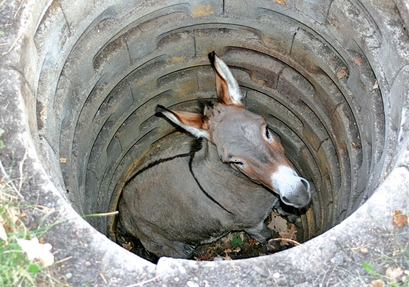
Meaningful Thoughts 0142 - Donkey in the well – Life lesson

This is story of donkey which teaches you a lesson. One day a farmer’s donkey fell down into a well . The animal cried piteously for hours as the farmer tried to figure out what to do. Finally, he decided that animal was old  and the well needed to be covered up anyway; it just wasn’t worth it to save the donkey.
He invited all his neighbors to come over and help him. They all grabbed a shovel and began to shovel dirt into the well. At first, the donkey realized what was happening and cried horribly. Then, to everyone’s amazement he quieted down.A few shovel loads later, the farmer was astonished at what he saw.
With each shovel of dirt that hit his back, the donkey would shake it off and take a step up.As the farmer’s neighborscontinued to shovel dirt on top of the animal, he would shake it off and take a step up. Pretty soon, everyone was amazed to see the donkey stepped up over the edge of the well and happily trotted off !
MORAL :
Life is going to shovel dirt on you, all kinds of dirt. The trick is to shake it off and take a step up. Each of our troubles is a stepping stone to higher success. We can get out of the deepest wells just by not stopping, never giving up ! Shake it off and take a step up.
Remember the five simple rules to be happy:
1. Free your heart from hatred – Forgive.
2. Free your mind from worries – Most of it never happen.
3. Live simply and appreciate what you have.
4. Give more.
5. Expect less from people but more from God.

Thursday, November 28, 2013

Meaningful Thoughts 0141 - The Dhammapada

"Conquer the angry man by love. 
Conquer the ill-natured man by goodness. 
Conquer the miser with generosity. 
Conquer the liar with truth." 
The Buddha (The Dhammapada)